THE OPPORTUNITY
Reach differently.
Think operationally.
Drone cleaning can reduce the need for personnel to access selected areas at height. Making it work takes more than an aircraft.
Aerofleye helps building owners, facility managers and maintenance partners assess where aerial cleaning fits—and develop the capability to use it responsibly.
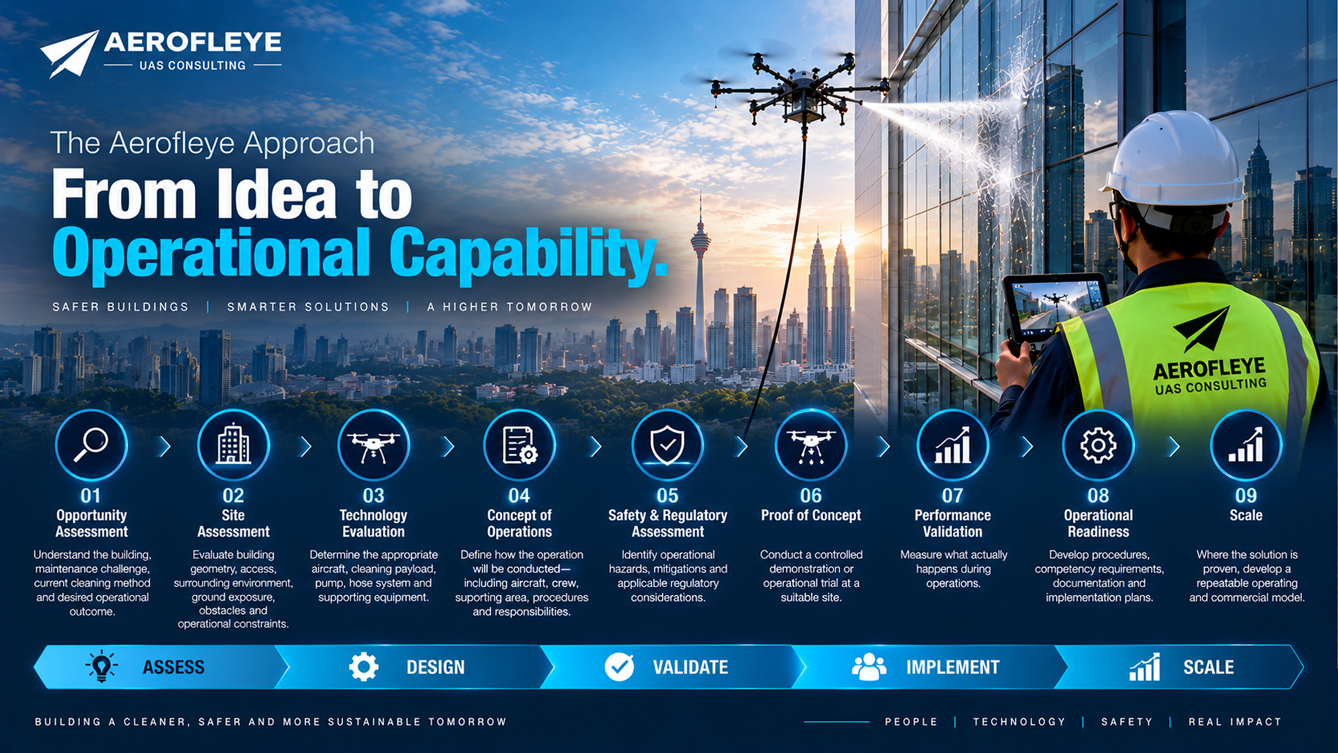
We start with your façade, access constraints and cleaning objectives. Then we shape the equipment, crew and procedures around the job.
THE CHALLENGE
From a building.
To a workable solution.
High-Rise Cleaning Has Always Been an Access Challenge.
Cleaning high-rise buildings and difficult structures often requires people, equipment and complex access systems to operate at height. Depending on the building, conventional operations may involve rope-access technicians, scaffolding, gondolas, mobile elevated work platforms or other specialised access systems.
These methods remain essential for many maintenance activities. But where the task is primarily surface cleaning, emerging aerial drone cleaning technology creates an opportunity to rethink how some work can be performed.
WHY DRONE CLEANING?
The value must be proven at the site—not assumed from the technology.
Reduce Work-at-Height Exposure
Where operationally suitable, drones can reduce the amount of time personnel need to spend directly exposed at height.
Faster Deployment
Suitable aerial cleaning systems may reduce some of the access infrastructure and mobilisation requirements associated with conventional methods.
Access Difficult Areas
Drones can potentially reach sections of façades and structures that are challenging to access using traditional equipment.
Operational Efficiency
A properly designed operation can explore improvements in deployment time, cleaning productivity and resource utilisation.
Data-Driven Operations
Cleaning coverage, operating time, water consumption, deployment time and productivity can be measured and evaluated.
HYBRID MAINTENANCE
Drones Don't Need to Replace the Maintenance Team.
The future of high-rise maintenance may not be drone versus conventional cleaning. It may be drone + human expertise.
Aerial cleaning can become another capability within the building-maintenance toolbox. Drones can perform suitable repetitive surface-cleaning tasks while experienced maintenance personnel continue to perform work requiring physical contact, detailed inspection, repairs and specialist access.
Hybrid maintenance model – use the right method for the right task.
MORE THAN A DRONE
The Drone is only one part of the system.
Every component interacts with the others. Aircraft performance affects payload capability. The hose affects aircraft behaviour. Building geometry affects GNSS performance and visibility. Wind interacts with the façade. The operating environment determines ground risk. Crew competency affects the ability to recognise and respond to abnormal situations. Aerofleye looks at the complete operational system.
SAFETY
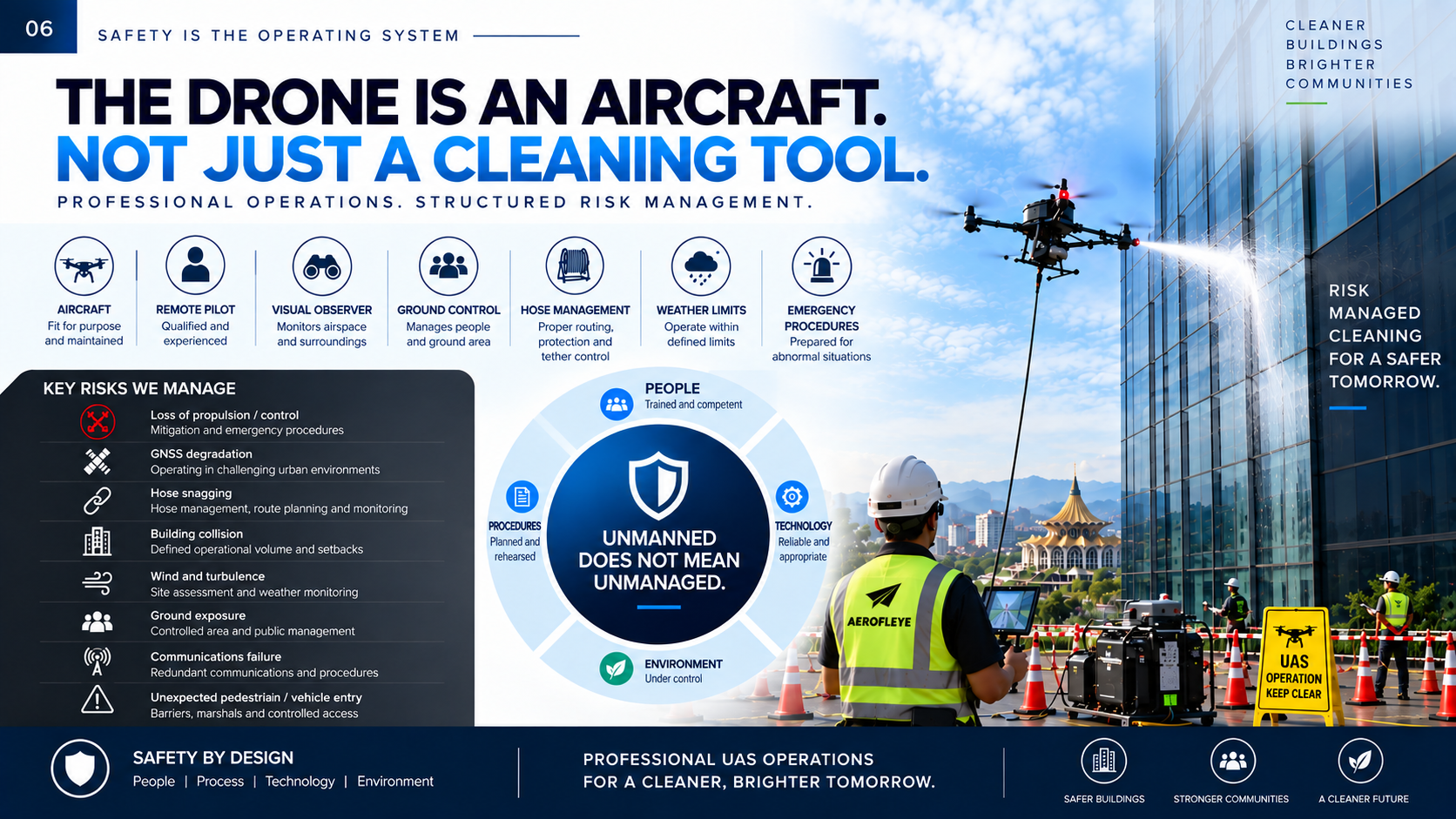
A cleaning drone is still an aircraft.
Imagine a cleaning drone operating beside an occupied building while connected to a pressurised hose. People may be below.
- What happens if the hose snags?
- What happens if GNSS performance degrades?
- What happens if wind conditions change around the building?
- What happens if command and control is degraded?
- What happens if the aircraft contacts the façade?
- What happens following propulsion failure?
These are aviation and operational-safety questions—not simply cleaning questions. Professional drone cleaning therefore requires structured risk management.
STRUCTURED OPERATIONAL RISK MANAGEMENT
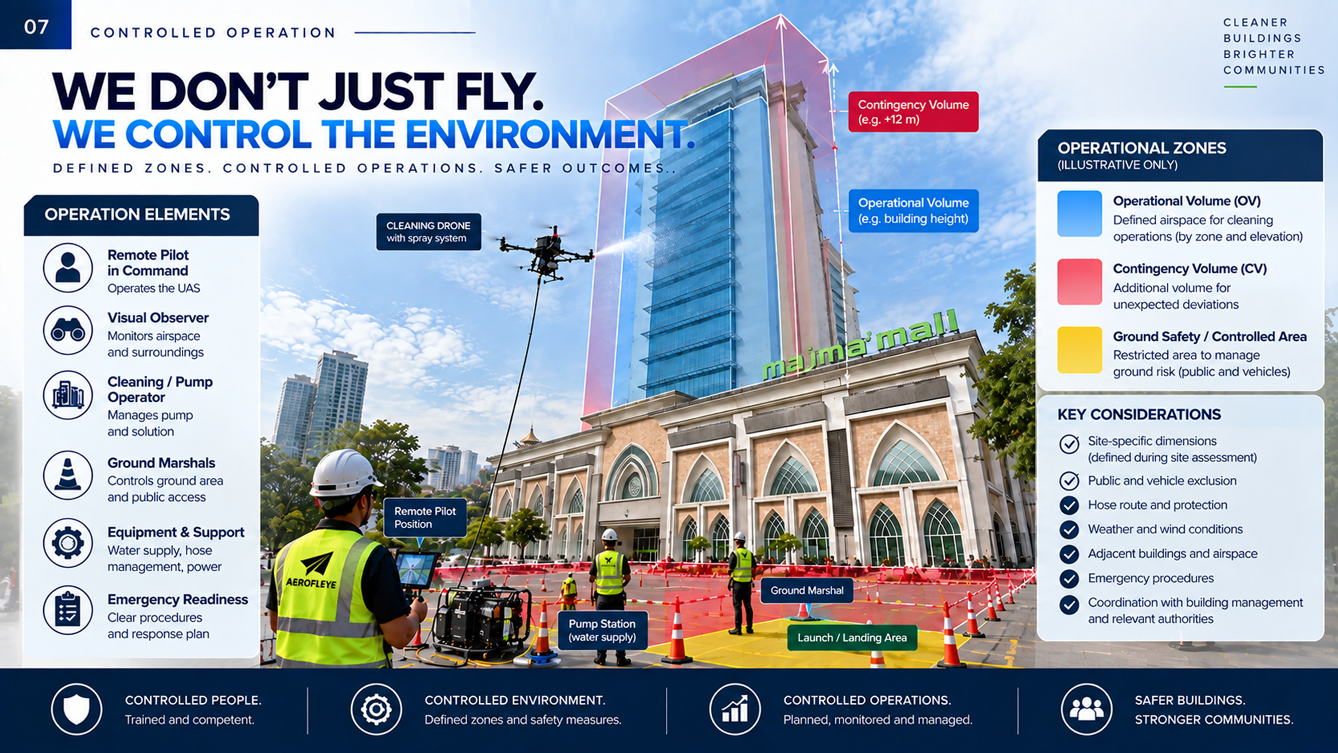
Where appropriate, structured methodologies such as SORA — Specific Operations Risk Assessment — may form part of the risk-assessment approach.
Concept of Operations — ConOps
How will the operation actually be performed?
Ground Risk
Who and what could be exposed below the aircraft?
Air Risk
What other airspace users could interact with the operation?
Containment
How will the aircraft remain within the intended operational area?
Ground Safety Buffer
What separation is required between the operation and people or property?
Abnormal & Emergency Procedures
What happens when the operation does not proceed as planned?
"Aerial drone cleaning is a specialised UAS operation requiring the right aircraft, cleaning system, operational procedures, trained personnel, risk controls and regulatory pathway."
DR. ZALIMAN YUSOFF, PRESIDENT OF MUVA
MALAYSIAN REGULATORY CONSIDERATIONS
A cleaning system.
An aviation operation.
Every building presents a different operating environment.
Depending on the proposed operation, aircraft, location and risk profile, regulatory requirements may need to be addressed with the Civil Aviation Authority of Malaysia (CAAM) and other relevant authorities.
Aerofleye can support clients in understanding and preparing the operational framework such as regulatory pathway, concept of operations, operational risk assessment, standard operating procedures, emergency response, operational documentation and approval preparation.
OPERATIONAL WORKFLOW
How a Professional Drone Facade Cleaning Project Works
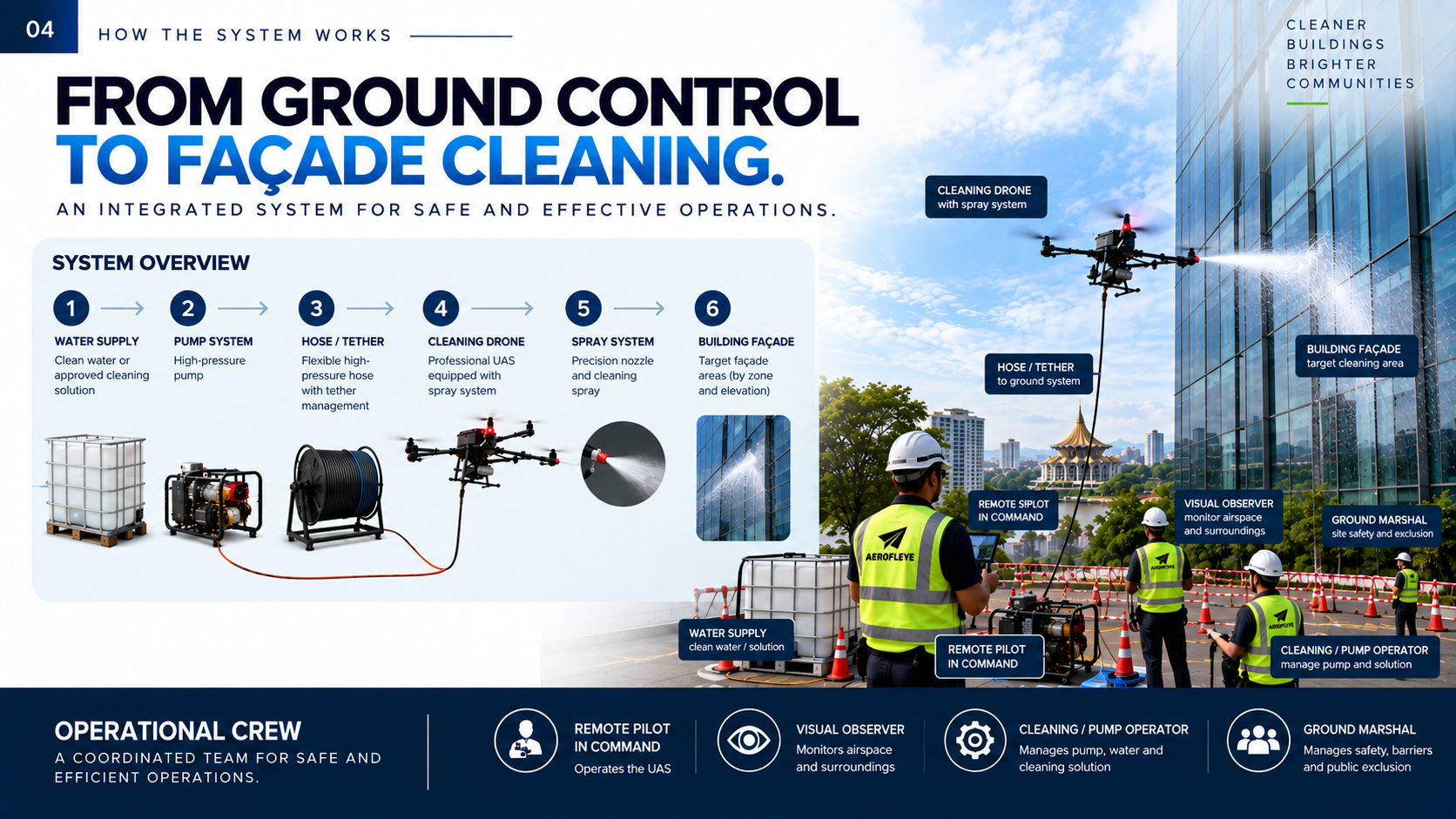
Aerofleye recommends treating each facade project as a documented cleaning workflow, and match the surface, soiling, water system, flight path, and safety plan before full-scale cleaning begins.
Step #1: Site Assessment
Review building height, facade geometry, roof or podium access, ground takeoff area, pedestrian zones, vehicle movement, wind exposure, GNSS environment, water source, drain points, and local flight restrictions.
STEP #2: Surface & Soiling Review
Identify glass, coated metal, stone, concrete, painted panels, signage, seals, frames, or sensitive materials. Review dust, salt, algae, bird droppings, industrial pollution, and long-term staining before choosing detergent and pressure settings.
Step #3: Test Patch
Before full-scale cleaning, test the planned method on a representative area. Confirm detergent compatibility, spray distance, pressure level, water spotting, runoff behavior, and visual result.
Step #4: System Configuration
Select the cleaning system, then confirm pump, hose length, nozzle type, foam workflow, pressure settings, battery rotation, ground crew roles, and spare parts.
Step #5: Cleaning Operation
Safety and Exclusion Zone:
Set up the takeoff and landing zone, hose route, pedestrian exclusion zone, emergency stop process, pilot/ground-crew communication, and post-cleaning runoff control.
Pilot-Supervised Cleaning:
Use manual spot cleaning, vertical A-B route cleaning, or area-based route cleaning depending on facade shape and site risk. The pilot remains responsible for monitoring standoff distance, wind, hose behavior, and surface response.
Step #6: Job Post Review
Record before/after photos, flight logs, cleaned area, water usage, detergent notes, surface observations, and customer reporting materials for future maintenance cycles.
Why Aerofleye?
Technology is easy to buy. Capability takes experience.
Aerofleye combines practical UAS industry experience, safety-by-design, Malaysian regulatory understanding and technology-independent thinking to develop operationally fit solutions. We focus on selecting technology around real requirements, managing risk from the outset, and validating technical, operational and commercial assumptions before scaling.
Implementation Options.
There is no single model for every organisation.
Aerofleye helps organisations select the right implementation approach—from outsourced professional services and in-house UAS capability to hybrid operations or strategic partnerships. The optimal model depends on operational frequency, facility portfolio, regulatory requirements, internal competency, investment priorities and commercial viability, ensuring capability aligns with real operational needs.
A FEW PRACTICAL QUESTIONS
Before you take off.
Is drone cleaning suitable for every building?
No. Suitability depends on façade materials, condition, geometry, access, surroundings and the type of contamination. A site assessment and controlled surface trial help establish a suitable method.
Can Aerofleye help with equipment as well as training?
Yes. Our consulting scope can include equipment evaluation, sourcing support, integration planning and training. Equipment supply arrangements, specifications, warranty and support are confirmed in a project proposal.
Does this replace aa conventional cleaning?
It may complement conventional methods. Some areas, defects and contamination still require manual attention or specialist access. The assessment identifies a practical combination.
What do you need to assess our building?
Share the location, approximate height, façade photos, surface materials, cleaning problem and available ground access. Existing maintenance requirements and a preferred timeframe also help.
LET'S ASSESS THE POSSIBILITIES
Could your building be a good fit?
Tell us about your property and the outcome you need. We'll help define a practical next step.
Start with your building.
Include its location, height, facade photographs and cleaning requirement in your enquiry.